
Kansa vs Stainless Steel: What Really Happens When You Cook With These Metals?
For decades, stainless steel has ruled modern kitchens. It’s shiny, tough, easy to clean, and marketed as the “safe” choice. But quietly and steadily Kansa (bell metal) has been making a comeback in homes that care about wellness, tradition, and mindful cooking.
This isn’t nostalgia.
It’s metallurgy, chemistry, and food science meeting ancient wisdom.
Let’s break down what truly separates Kansa and stainless steel, beyond myths and marketing and help you understand where each metal genuinely belongs in your kitchen.

Two Philosophies of Cookware
At a fundamental level, Kansa and stainless steel are built on opposite ideas.
- Stainless steel is designed to be passive: it does nothing, reacts with nothing, and stays the same forever.
- Kansa is active: it responds to heat, food, time, and use and even interacts with what you eat.
Neither approach is wrong. But they serve very different purposes.
What Is Kansa, Really?
Kansa is not brass.
It’s not ordinary bronze.
Authentic Kansa is a high-tin bronze alloy, traditionally made with:
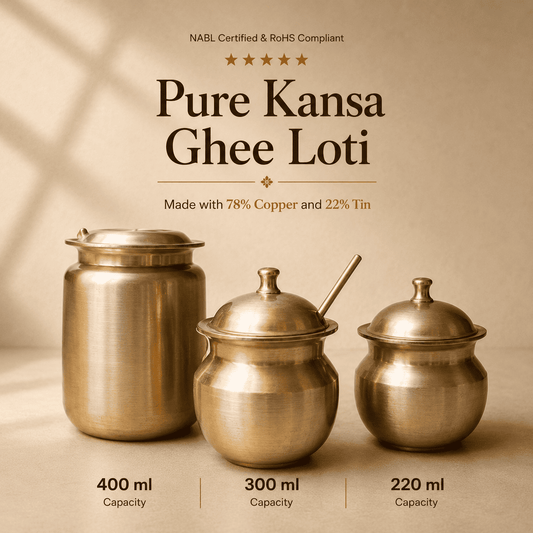
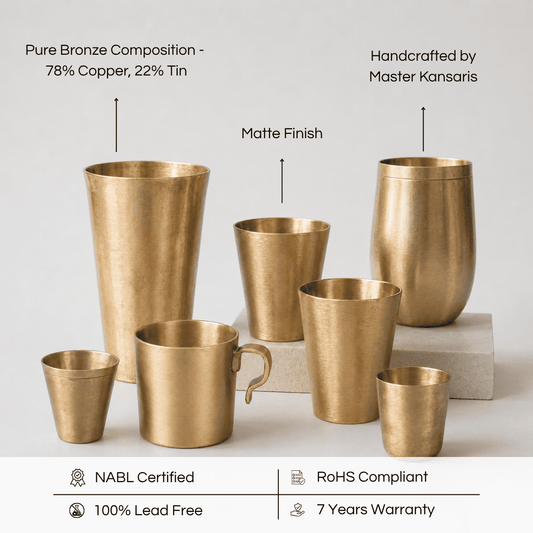
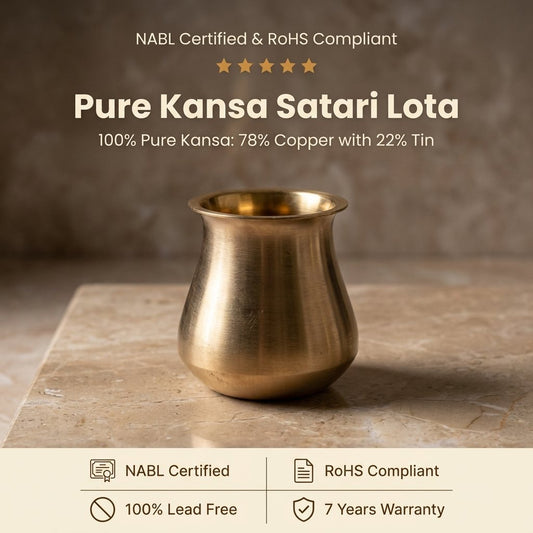
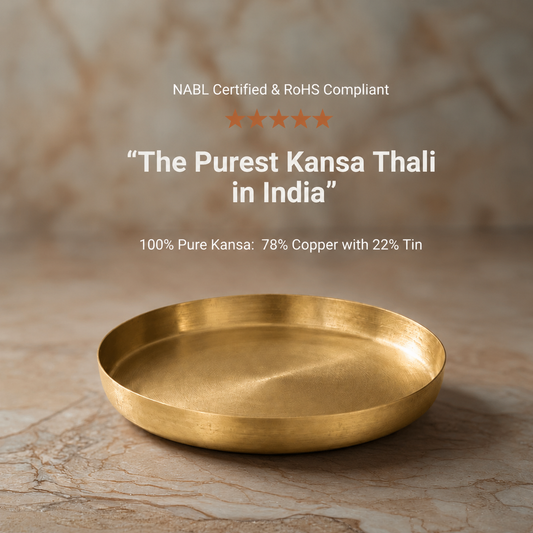
- ~78% Copper
- ~22% Tin
This exact ratio is crucial. Too little tin, and it behaves like soft bronze. Too much, and it becomes dangerously brittle.
At this composition, Kansa develops:
- Exceptional hardness
- A pale gold to silvery tone
- A clear, bell-like resonance when tapped
That ringing sound isn’t poetic it’s a real test of authenticity. If a vessel sounds dull, it’s usually brass or adulterated metal.
Stainless Steel: The Industrial Benchmark
Most kitchen steel today is 304 stainless steel (often labeled 18/8 or 18/10).
Its strength lies in one thing: a self-healing chromium oxide layer that forms instantly on the surface when exposed to air. This invisible shield:
- Prevents rust
- Stops chemical reactions
- Keeps food flavors unchanged
Stainless steel is engineered for:
- Consistency
- Durability
- Zero involvement with food chemistry
It’s reliable. Predictable. And intentionally boring.
Heat: Where the Difference Becomes Obvious
Why Stainless Steel Gets Hot Spots
Stainless steel is a poor conductor of heat. Heat stays where it hits, creating hot spots directly above the flame. This is why many steel pans burn food unevenly unless they have aluminum or copper cores.
Why Kansa Heats More Evenly
Kansa conducts heat 2–3 times better than stainless steel. While it’s nowhere near pure copper, it spreads heat laterally far more efficiently than steel.
The result:
- Fewer hot spots
- More even browning
- Better control during slow cooking
The “Dum Cooking” Advantage
Kansa vessels are traditionally thick and heavy and that’s intentional.
Once hot, they:
- Hold temperature steadily
- Release heat gently
- Resist sudden fluctuations
This makes Kansa ideal for:
- Slow-cooked dals
- Milk reduction (rabri, kheer)
- Gentle simmering
- Traditional dum-style cooking
Stainless steel heats quickly but cools just as fast. Kansa stays warm longer, especially at the dining table.
Reactivity: Inert vs Alive
Stainless Steel: Neutral and Safe
Stainless steel does not react with:
- Tomatoes
- Tamarind
- Vinegar
- Lemon
- Fermented foods
It adds nothing. It removes nothing.
This makes it perfect for acidic cooking and food storage.
Kansa: Controlled Interaction
Kansa is semi-reactive.
With mildly acidic foods:
- It slightly neutralizes acidity
- Releases trace copper and tin ions
- Alters food chemistry subtly
This is why Ayurveda describes Kansa as alkalizing and digestive-supportive.
But there’s a boundary.
What You Should NEVER Do With Kansa
Traditional wisdom here is surprisingly precise and scientifically correct.
❌ Do not store acidic food
❌ Do not leave sour curries overnight
❌ Do not store pickles, tamarind, or vinegar-based foods
❌ Do not store ghee long-term
Why?
-
Strong acids can corrode copper
-
Copper accelerates fat oxidation
-
Ghee turns rancid faster in bronze
Kansa is meant for cooking briefly and serving, not long-term storage.
Health Benefits: Myth vs Measured Reality
What Ayurveda Says
Kansa is considered:
- Cooling
- Digestive-supportive
- Balancing to all three doshas
- Sattvic (promoting clarity and calm)
It’s even used in Kansya foot massage to draw excess heat from the body.
What Science Confirms
Modern studies support several benefits:
- Trace copper intake (essential for enzymes, iron absorption)
- Antimicrobial action (copper alloys kill bacteria on contact)
- Water purification when used as drinking vessels
Stainless steel, by contrast, is hygienic but not antimicrobial.
Durability: Tough vs Hard
This is a crucial distinction.
- Stainless steel is tough: it dents but doesn’t break
- Kansa is hard but brittle: it resists wear but can crack if dropped
A steel pot survives abuse.
A Kansa pot demands respect.
That’s not a flaw, it’s part of the relationship.
Maintenance: Convenience vs Ritual
Stainless Steel
- Dishwasher safe
- Scrub aggressively
- Forget about it
Kansa
- Hand wash only
- Dry immediately
- Polish occasionally with lemon or tamarind
- Allow patina to form naturally
Kansa ages. Steel doesn’t.
So… Which One Is Better?
| Feature | Kansa (Bell Metal) | Stainless Steel (304/Tri-ply) |
| Thermal Conductivity | Moderate (~40 W/mK) - Better evenness | Low (~16 W/mK) - Prone to hotspots |
| Heat Retention | High (High Mass) | Low (Rapid cooling) |
| Acidity Tolerance | Low (Reacts with pH < 4) | High (Inert to all acids) |
| Induction Compatible | No | Yes (if magnetic base added) |
| Dishwasher Safe | No | Yes |
| Microbial Safety | Active (Kills bacteria) | Passive (Hygienic surface) |
| Durability | High wear resistance, but Brittle | High impact resistance, Tough |
| Aesthetic | Golden, Traditional, Warm | Silver, Modern, Industrial |
The honest answer: neither replaces the other.
Use Stainless Steel for:
- Acidic curries
- Boiling and steaming
- Storage
- Rough, daily cooking
Use Kansa for:
- Eating and serving
- Drinking water
- Dairy-based dishes
- Slow cooking
- Wellness-focused kitchens
The Ideal Kitchen Isn’t Exclusive, It’s Intentional
A modern, conscious kitchen doesn’t reject stainless steel.
It reintroduces Kansa where it belongs. Steel for efficiency. Kansa for nourishment, warmth, and connection. Not everything needs to be optimized. Some things are meant to be experienced.
References:
-
AZoM – Grade 304 Stainless Steel: Properties, Fabrication and Applications
Comprehensive overview of composition, corrosion resistance, and thermal properties of austenitic stainless steel. - Engineers Edge – Thermal Properties of Metals. Data source for thermal conductivity, specific heat, and diffusivity comparisons between metals.
- PMC (NIH) – Temperature and pH Affect Copper Release Kinetics from Copper Metal Foil and Commercial Copperware. Scientific study explaining copper ion release, acidity interactions, and food safety thresholds.
- Journal of Pharmaceutical and Scientific Innovation (JPSI) – Experimental Study of Ghee Stored in Bronze Vessels. Research validating oxidative rancidity of ghee when stored in bronze and traditional Ayurvedic prohibitions.
-
Eaglador – What Is Kansa Bronze and Why It’s Used in Cookware
Practical insights into bell metal composition, care, and modern usage. - Heritage Steel – The Five Rules of Good Cookware. Contemporary cookware science and material behavior in professional kitchens.
- NIH / Copper Development Association – Antimicrobial Properties of Copper and Copper Alloys. Research confirming contact-killing behavior of copper-based alloys.