
The Story of Odisha’s Bell Metal Craft and the Kansari Community

In the quiet villages of Odisha, the day often begins not with alarms or engines but with rhythm.
A steady, echoing clang.
Hot metal meeting hammer.
Again. And again.
This sound, known locally as Pita, has shaped lives, kitchens, temples, and traditions for over a thousand years. It is the sound of Kansa - Odisha’s bell metal - being forged by the Kansari community, the hereditary custodians of one of India’s most ancient and meaningful crafts.
This is not just a story of metal utensils.
It is a story of food, faith, sound, science, and survival.
Why Kansa Is More Than a Metal

In India, metals carry meaning. Gold signifies wealth. Iron represents strength. Copper purifies water.
But Kansa, a high-tin bronze alloy, occupies a category of its own.
In Odisha, Kansa is not optional. It is essential.
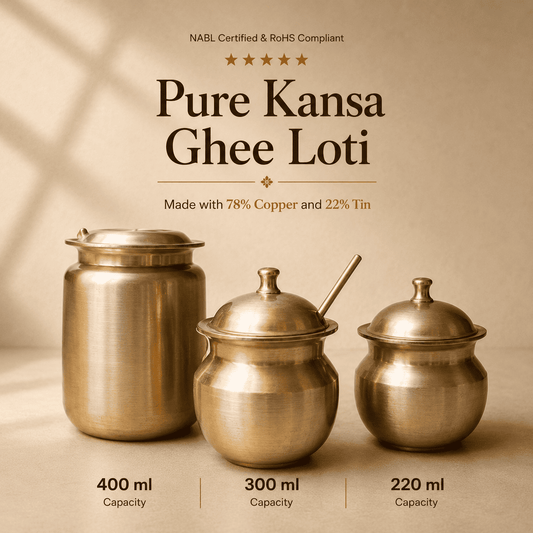
From the first solid food fed to a child (Annaprasana), to wedding trousseaus, temple offerings, and even funeral rites, Kansa accompanies every major life moment. Its pale golden hue deepens with age, and when struck, it produces a clear, lingering resonance that feels almost spiritual.
Ask an Odia household why Kansa matters, and the answer often isn’t philosophical.
“It’s what food should be eaten in.”
The Kansari Community: Keepers of the Craft

The makers of Kansa are known as Kansaris (also called Thattari, Kharura, or Tamera in different regions of Odisha).
According to community lore, their ancestors migrated from Kanyakubja (Kannauj) once a great North Indian cultural center, after royal invitations from Odishan kings who needed skilled artisans to serve temple economies.
Their most important early settlement was Kantilo, near the Mahanadi River strategically located for:
- Water access
- Transport of metals
- Proximity to temple centers
From there, Kansa production spread to Balakati, Bhatimunda, Remuna, and Bellaguntha each developing its own stylistic identity.
Socially, Kansaris occupy a unique space:
- Classified as Shudras
- But considered ritually “clean”
- Their vessels are acceptable even inside temple sanctums
Without this status, Jagannath Temple rituals would be impossible.
Inside a Kansari Workshop: Where Metal Breathes
Kansa is not cast in molds like factory utensils.
It is forged by hand, using a process called Pita.
This is hot forging in its most primal form.
The Process, Simplified:
- Melting the alloy in clay crucibles
- Forming ingots (called Malla)
- Repeated heating and hammering
- Constant reheating - strike too cold and it shatters
- Shaping, scraping, tempering, and polishing
A single plate may be heated and beaten dozens of times.
This work demands:
- Physical strength
- Perfect timing
- Deep intuitive knowledge of metal behavior
The rhythm of hammer strikes isn’t random, it’s synchronized teamwork.
Miss the rhythm, and weeks of work can crack in seconds.
Women, Recycling, and the Forgotten Economy
While men handle the furnace and hammer, women have always been central to Kansa’s survival.
- Cleaning and polishing
- Managing household barter systems
- Exchanging broken utensils for new ones by weight
This created a closed-loop recycling economy, where no metal was ever wasted.
What sustainability experts celebrate today, Kansaris practiced centuries ago.... quietly.
Kansa and the Jagannath Temple

If one institution has kept Kansa alive through centuries, it is the Jagannath Temple in Puri.
Temple rules are strict:
- Food for the deities is cooked in earthen pots
- Served only in Kansa
- Ritual bells must be made of specific bell metal for sound purity
The temple’s daily demand sustained entire artisan clusters for generations.
Kansa is not just functional here, it is sacred infrastructure.
References:
- Joshua Project. (n.d.). Kansali in India.
- Kansabanik. (n.d.). In Wikipedia.
- Map Academy. (n.d.). Kansari Brass and Bell Metal Ware.
- Journal of Current Research in Arts. (n.d.). Anthropological Fieldwork among the Kansari.
- Oaklores. (2025). Clang, Craft, and Kansari: The Ringing Legacy of Balakati’s Bell Metal.
- Ikai Asai. (n.d.). Kansa Metal: Where It Stands Today.
- Studio Bead. (n.d.). Unveiling Odisha’s Glittering Legacy: Bell Metal Artisans.
- D'Source. (n.d.). Bell Metal Design Orissa: Introduction.
- Visit Bhubaneswar. (n.d.). Bell Metal and Dhokra.
- Census of India. (1981). History of origin and development of the craft.
- Odisha Review. (2017). Brass and Bell-metal Industries of Odisha.
- Natriel. (n.d.). Traditional Utensil of India.
- Times of India. (2022). Odisha's brass and bell metal wares all set to get GI tag.
- MyScheme. (n.d.). Mukhyamantri Kalakar Sahayata Yojana.
- Serials Journals. (n.d.). Brass Craft Tradition of Bellaguntha.
- Odisha Craft Odyssey. (n.d.). Revitalising the Bell Metal Craft.
- Odisha TV. (2024). Odisha bell metal industry on brink of collapse.